How do frozen riverbeds erode?
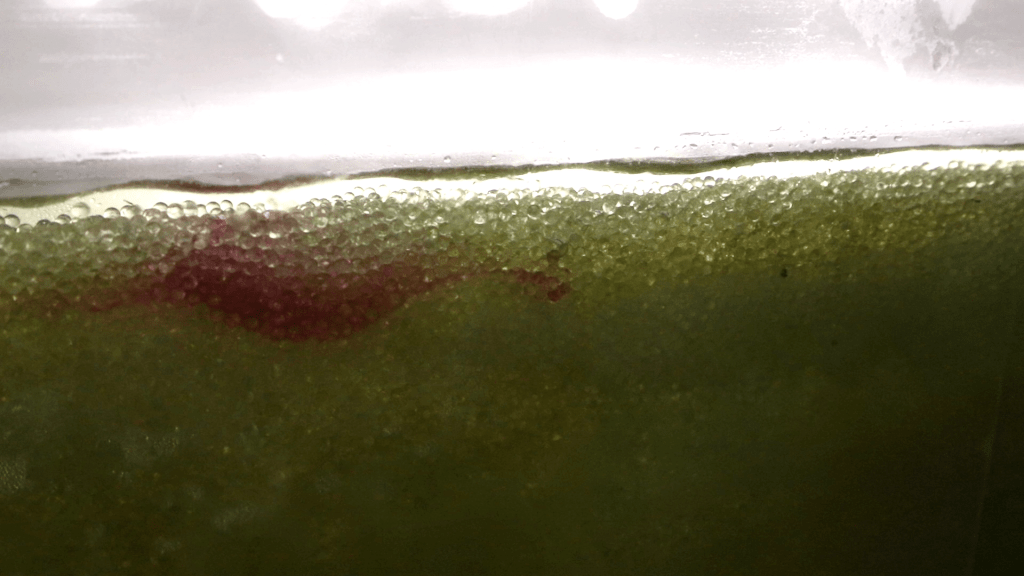
Rivers are an essential part of landscapes on Earth, carrying with them a fingerprint of climate, life, and lithology. However, we know very little about how new river channels are forming in landscapes that are seasonally frozen. In this project, we are combining novel laboratory experiments with field observations from the Canadian High Arctic to explore this.
Contrary to common assumptions, ice in riverbeds increases erosion rates through a process we call coupled thaw-entrainment. As a result, Arctic channel network evolution is accelerated relative to temperate environments and most sensitive to early season extreme weather events. Over time coupled thaw-entrainment at the landscape-scale likely results in distinctly discontinuous channel networks characteristic of High Arctic periglacial landscapes.
Coupled thaw-entrainment fundamentally challenges the view that riverbed erodibility is purely a function of the bed surface and surface flow conditions. Instead, it shows how subsurface water flow, so-called hyporheic flow, also contributes to erosion.
Motivation
Imagine you are standing by a small stream. On the channel bed you might see individual sediment grains moving downstream. This is what river erosion looks like at the grain-scale and by counting how many particles move at a given point in space and time, you can measure how quickly that stream is eroding the landscape. Now imagine the water stops flowing, the channel bed freezes and then water begins flowing over the now frozen bed again. Do you think more or less grains will move? And how do you think this will change as the bed thaws?
This thought experiment inspired our initial laboratory experiments to quantify how pore ice in a riverbed changes the erodibility of its sediment. Polar and high mountain cold regions on Earth are undergoing a strong seasonal cycle where the ground freezes fully during the winter and thaws from the surface downward every summer. In this project, we are interested in how this seasonal cycle is changing when, where and how new river channels form.
Flume experiments
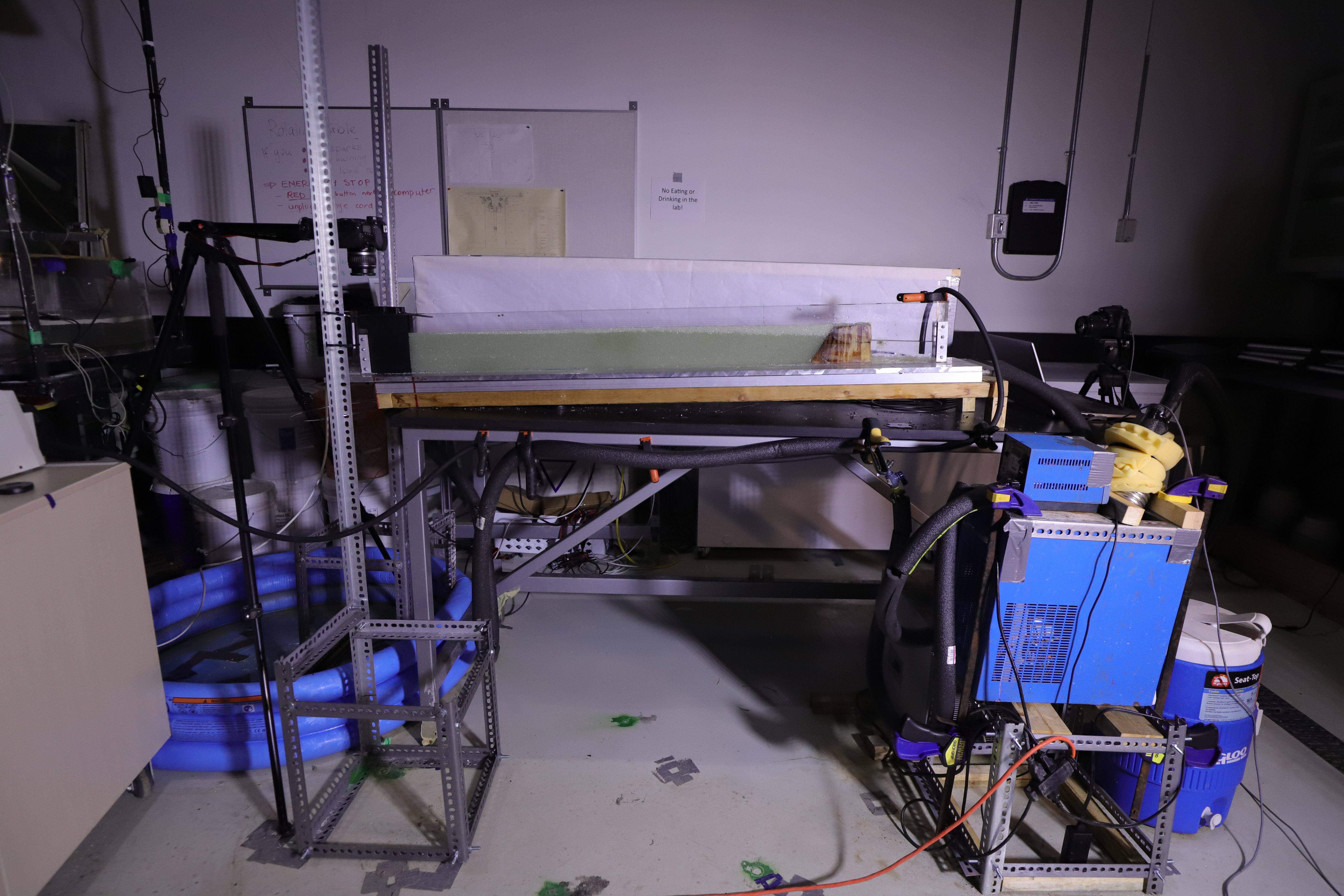
We’ve built a novel flume set-up that allows us to compare erosion rates for unfrozen and thawing sediment beds directly. The 1.5m long flume is portable so that we can transfer it between the tabletop where the experiments are run and a freezer. This way we can fully freeze a bed before running the experiment in the same conditions as the unfrozen counterpart.
Through the transparent side walls we can image the evolving thaw front, water and bed surfaces, as well as observe subsurface flow structures using dye tracers. At the outlet we measure particle flux from top-down video.
Thanks to the small size of the set-up, experiments are relatively fast to run, allowing for many repeats and an easy way to test new ideas.
The coupled-thaw entrainment model
As a channel bed thaws, the frozen-unfrozen interface in the bed (thaw front) acts as an impermeable boundary, trapping any water flow within the top layer. In the early thaw season, when the thaw front is shallow, surface water injections hit the thaw front and are redirected upwards, resulting in overturning convective stirring within the bed. This convection has two effects. First, it disrupts the bed structure generating a buoyancy force that helps pick up more sediment particles, enhancing erosion. Second, it delivers heat directly to the thaw front, locally enhancing thawing which causes the thaw front to become undulated. These undulations generate hydrostatic pressure gradients that localise erosion and drive the formation of stepped topography on the bed surface. These undulations continue to grow until the thaw front is deep enough that surface water injections do not reach it anymore. However, the undulations continue to localise erosion for the remainder of the season.
Implications for Arctic landscapes
Coupled thaw-entrainment suggests that, for the same magnitude-duration discharge event, erosion rates are greatest early in the thaw season. As such, Arctic channel networks are likely most sensitive to early season extreme weather events, rather than an overall lengthening of the thaw season.
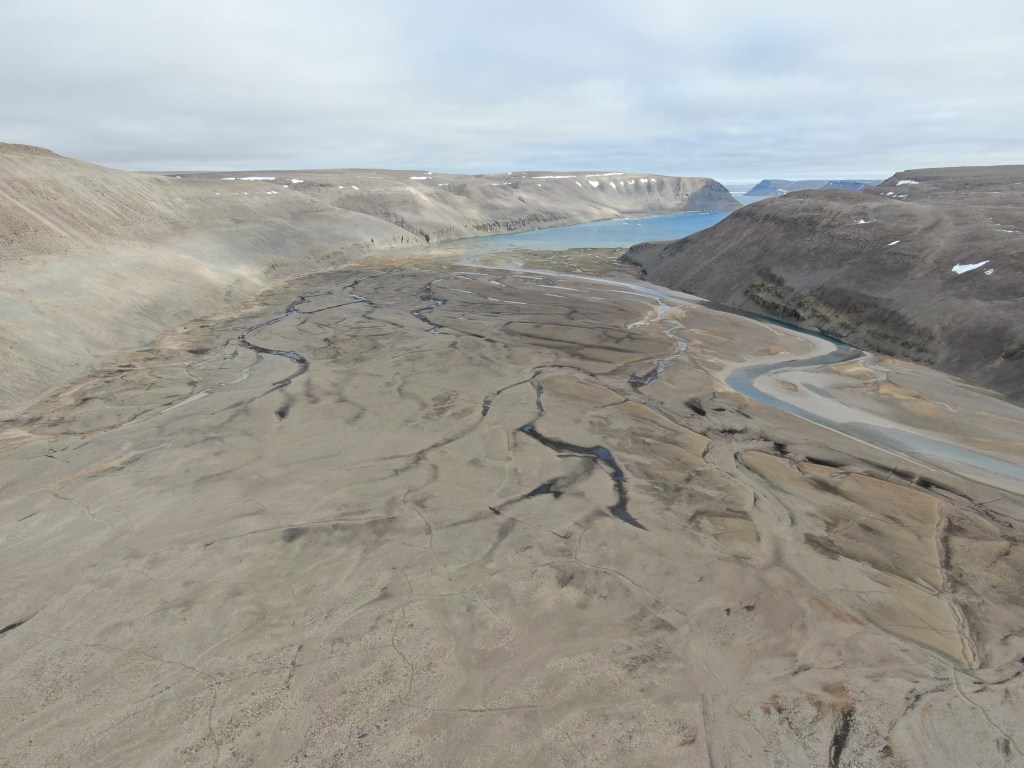
Over multiple thaw season, small surface steps grow to form a distinctly discontinuous landscape, which we observe across the Canadian High Arctic. This suggests that seasonal freezing and thawing potentially leaves a long-lasting impression on the landscape that can persist centuries even after seasonal freezing has ended.
 Home
Home 